

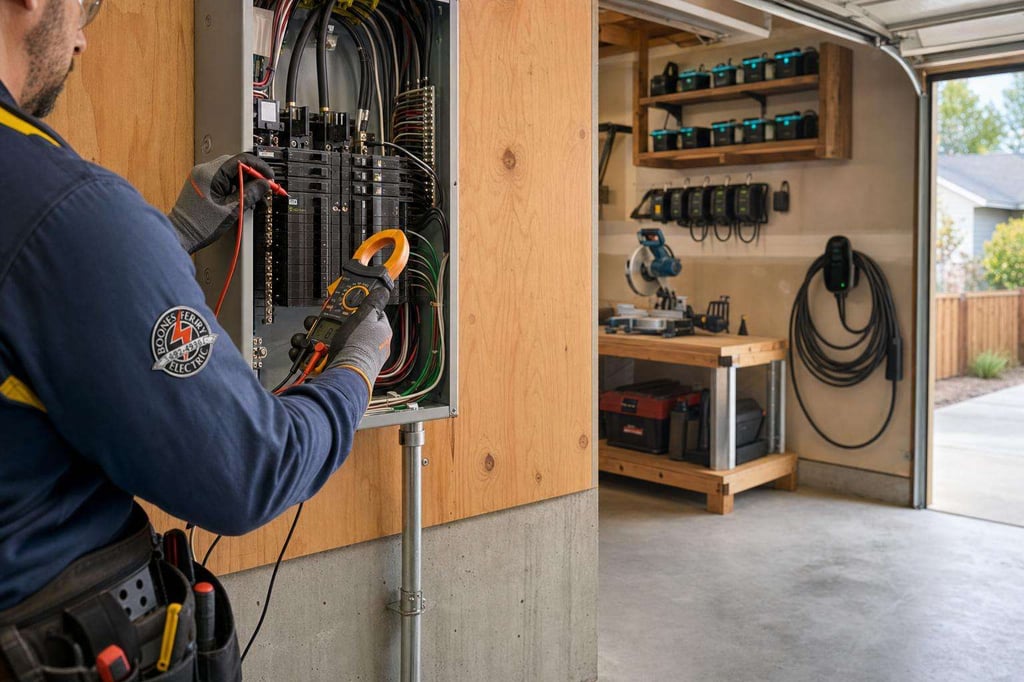
Why Detached Garages Often Need More Than a Basic Circuit
A detached garage can be much more than a place to park a car. Many Wilsonville and Portland Metro homeowners use these spaces for woodworking, automotive projects, home gyms, storage, EV charging, or small business tasks. As the demand for power increases, a single branch circuit may not be enough to support lighting, receptacles, power tools, heating, ventilation, and charging equipment safely.
A detached garage subpanel provides a dedicated distribution point for garage circuits. Instead of overloading existing wiring or relying on extension cords, a properly designed subpanel allows a licensed electrician to organize the garage’s electrical installation around the equipment you actually plan to use.
What Is a Detached Garage Subpanel?
A subpanel is a secondary electrical panel fed from the main service panel. In a detached garage, it can supply multiple circuits for receptacles, lighting, tools, chargers, and other equipment. The size and configuration depend on several factors, including available capacity at the main panel, distance to the garage, expected electrical load, local code requirements, and future upgrade plans.
Because a detached structure has additional grounding, bonding, trenching, and disconnect considerations, this work should always be evaluated and completed by a licensed professional.
Common Reasons to Add a Garage Subpanel
Workshop Circuits
Workshops often need dedicated circuits for saws, compressors, dust collection, welders, heaters, or specialty equipment. A subpanel can help separate high-demand tools from general lighting and receptacle circuits, reducing nuisance trips and improving usability.
- Woodworking and metalworking tools
- Air compressors and dust collectors
- Dedicated receptacles for stationary equipment
- Improved lighting layouts for workbenches and task areas
EV Chargers and Vehicle Equipment
If you are planning an EV charger in a detached garage, the electrical load should be reviewed carefully. A licensed electrician can evaluate your main service capacity, panel condition, feeder requirements, and charger specifications before recommending the right approach.
Some homes may need electrical upgrades before adding larger loads. Others may be able to support a charger with the correct circuit design and load calculation.
Tool Circuits and Dedicated Receptacles
Heavy-duty tools may need individual circuits to operate safely and reliably. A detached garage subpanel makes it easier to add dedicated circuits where they are needed, rather than stretching one general-purpose circuit across too many devices.
- Table saws and miter saws
- Battery charging stations
- Garage refrigerators or freezers
- Vehicle maintenance equipment
- Outdoor or exterior garage receptacles
Planning Considerations Before Installation
Main Panel Capacity
Before a subpanel can be added, your main panel and overall service capacity need to be reviewed. A Wilsonville electrician can determine whether the existing equipment can support the additional load or whether panel changes or other electrical upgrades are needed.
Feeder Size and Distance
Detached garage subpanels are typically fed by wiring that runs from the main service equipment to the detached structure. The distance, amperage, wiring method, and installation environment all affect the design. Underground feeder installations may also require trenching, conduit, and inspection coordination.
Grounding, Bonding, and Disconnect Requirements
Detached structures have specific safety requirements. Grounding and bonding must be handled correctly, and a disconnect may be required at the detached building. These details are not optional; they help reduce shock and fire risks and support code-compliant operation.
Future Expansion
If you plan to add an EV charger, larger tools, heating, cooling, or a finished workspace later, it is worth discussing future needs during the design stage. Thoughtful planning can make the installation more practical and help avoid unnecessary rework.
Signs Your Garage Electrical Setup May Be Undersized
You may want to request an evaluation if your detached garage has any of the following issues:
- Breakers trip when tools or equipment start
- Lights dim when larger loads turn on
- There are too few receptacles for safe, convenient use
- Extension cords are being used as a long-term solution
- You want to add an EV charger or high-demand tool
- The garage wiring is older, damaged, or unlabelled
These symptoms do not automatically mean you need a subpanel, but they are good reasons to schedule a professional inspection.
Why Work With a Licensed Electrician
Detached garage power involves more than adding a few outlets. Proper load calculations, feeder sizing, grounding, bonding, panel selection, permitting, and inspection requirements all matter. Working with a licensed electrician helps ensure your garage electrical installation is designed for safe, dependable use.
Boones Ferry Electric provides residential electrical repair, commercial electrical services, industrial electrical services, electrical upgrades, and electrical installations throughout Wilsonville, Tualatin, Lake Oswego, Oregon City, and the Portland Metro area.
Local Electrical Services for Detached Garage Projects
Whether you are building a workshop, preparing for an EV charger, or improving an existing detached garage, Boones Ferry Electric can evaluate your current system and recommend practical next steps. If you are searching for electrical services Wilsonville or a Portland Metro electrician with experience in residential, commercial, and industrial electrical services, our team is ready to help.
Request Service From Boones Ferry Electric
Electrical work should always be evaluated and completed by a licensed professional. For dependable detached garage subpanel planning and installation, contact Boones Ferry Electric today. For practical next steps, Request service and talk with the team about timing, scope, and the right path for your situation.
Frequently Asked Questions
Not every detached garage needs a subpanel, but one may be recommended if you plan to run multiple tools, dedicated equipment, improved lighting, heating, or charging equipment. A licensed electrician can review your main panel capacity, current wiring, and expected loads before recommending the right solution.
In many cases, yes, but the installation depends on your home’s electrical capacity, the charger requirements, feeder distance, and the condition of existing equipment. A professional evaluation is important before adding a high-demand charging circuit.
Common workshop circuits include general receptacles, dedicated tool circuits, task lighting, exterior receptacles, battery charging areas, dust collection, compressors, and heating or ventilation equipment. The best layout depends on how you use the space and what equipment will operate at the same time.
Detached structures have specific grounding, bonding, and disconnect requirements that must be handled correctly. Requirements can vary by installation details and local code, so this work should be designed and completed by a licensed electrician.
Yes. Boones Ferry Electric provides electrical services in Wilsonville and the Portland Metro area, including detached garage subpanel planning, electrical installation, residential electrical repair, and electrical upgrades for workshops, chargers, and tool circuits.